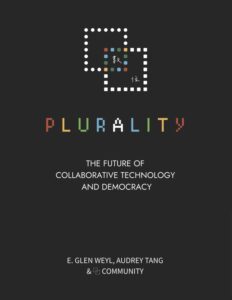
I spent a good few weeks reading and trying to grok a book, Plurality: The Future of Collaborative Technology and Democracy, by E. Glen Weyl and Audrey Tang and their community. I knew about Audrey Tang as she has been the Digital Minister of Taiwan and I had read about her a few times. I first heard about the book when the authors presented it at the re:publica 2024 in Berlin. Do check out the talk, it is a great introduction:
If you want to know more, the book – in true hacker spirit – is open source and available as a free download. Go and get it!
So what is so interesting about it?
The book is about digital democracy and the efforts to establish it in Taiwan (which seems to be an amazing example for a digital nation). One key idea is that we should see democracy as a system that we can code and develop, and that technology should be organised more democratically, not like a monarchy:
„Taiwan’s experience shows us that more options may be available for our technological future, making it more like politics, and that one of these may involve radically enhancing how we live together and collaborate, progressing democracy much like we do technology“. (p. 89)
Plurality
The key concept is plurality, displayed as the symbol ⿻ in the book. Apparently, the Chinese characters 數位 mean both ‚digital‘ and ‚plural‘, and the authors show how there’s a strong connection between the two sides. They argue that intersecting diverse social groups and people are the core fabric of the social world, and that human identities are defined by combinations and intersections of various forms of plurality (the way you can be a member of a family, a neighbourhood, one or several clubs etc. etc.). Beyond this, the authors use the concept to describe a social philosophy of the technological era, advocating for a third way beyond libertarianism and technocracy.
What would a society and information technology built on an analogous understanding of human society look like?
The authors argue that a ⿻ society must be founded on infrastructure that matches the principles of ⿻ in form and substance – so it should itself be open, democratic and able to reflect the plurality of its participants. Some of the steps towards this they propose:
- Build tools that pursue the goals of a range of social groups; reform market function by focusing on social welfare; build rich ways for people to empathise.
- share assets more effectively! We could buy half a decade more of Moore’s Law. Several times as many semiconductors are used in personal devices as in cloud/data centres.
Taiwan is presented as a great example for this (and from what I can see, it is). The book gives numerous examples of pro-social digital innovation and of technologies for collaborative diversity that are deeply rooted in daily life. It was fascinating to read how there is a tradition of hackers working together with the administration on projects like g0v (a collaborative effort to „rethink the role of government from zero“), vTaiwan (testing an open consultation process) or Cofacts (a collaborative fact-checking system designed to fight propaganda spreading via fake news).
The authors argue that their policy approach, like Taiwan itself, lies at the intersection of the American, European and Chinese digital empires, drawing inspiration from all of them: „Together these add up to a model where the public sector’s primary role is active investment and support to empower and protect privately complemented but civil society-led technology development whose goal is proactively building a digital stack that embodies in protocols principles of human rights and democracy.“ (p.391, original emphasis)
Weyl, E. G., Tang, A., & ⿻ Community. (2024). ⿻ 數位 Plurality: The Future of Collaborative Technology and Democracy. Independently published. https://www.plurality.net/chapters/