A new way to conceptualize data and information can give insights into what happens when we digitalize business processes – starting from the facts of the world and considering how they can be turned into data and information.
While technological progress is driving digital transformation and creating opportunities to collect and analyze data at unprecedented scale, many organizations are still struggling to digitalize their business processes – as illustrated by, e.g., Germany’s medoicre ratings in the EU’s Digital Economy and Society Index.
It is clear that data needs to be collected and the right information presented for Information Systems to support making business decisions. But what exactly is data or information? Information Systems research is vague on these terms, seeing data and information as largely synonymous [1] , thus failing to offer any conceptual help on what happens in the process of digitalization.
That’s why I developed a framework for discussing what happens in the digitalization of business processes, which I presented at the DIGITAL conference in Venice this summer. I hope this will help to start discussions: If we see data as digital representations of facts (or signs) of the world, and information as views of specific digital data, enriched by relevant context, not only do we get unambiguous definitions which are also close to their literal meanings, data as „that which is given“ and information as „that which is formed“. It can change our view of what happens in digitalization1.
A Framework for Digital Business Processes
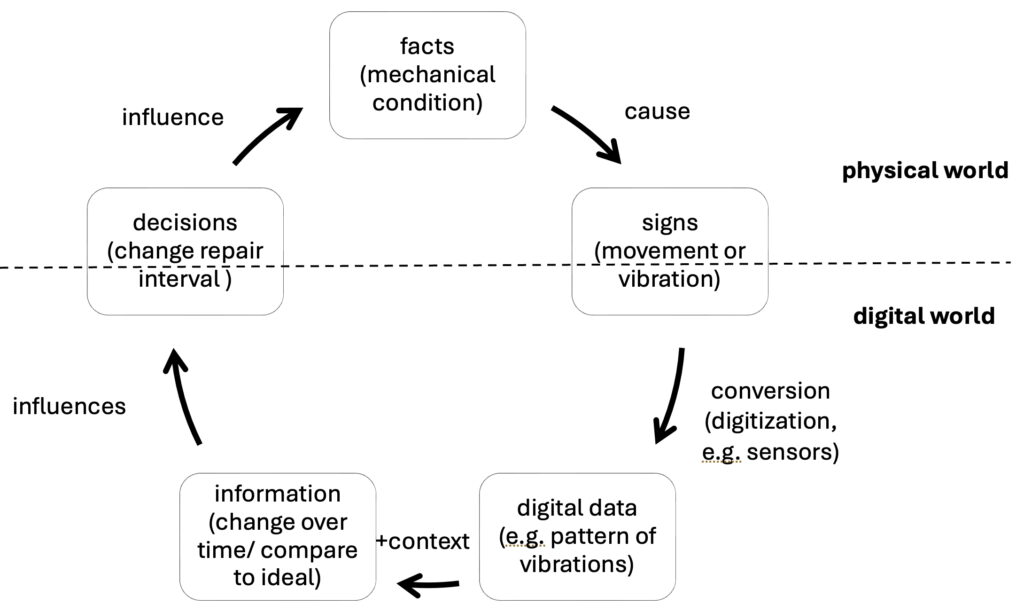
This is illustrated in my Framework (see figure): In the process of digitalization, relevant facts of the world are identified. Next, measurable signs relating to these facts are identified. These signs are then digitalized, i.e., converted into digital data if needed. The digital data is then enhanced with context and presented in a way that is useful for supporting decisions, i.e., it is turned into information. This information is then presented in a way that can support decisions, either by humans or automated systems:
figure 1: Framework
This worked well in describing the case of predictive maintenance of railway tracks using smartphones [3]:
- The starting point is facts of the world, i.e., the mechanical condition of a railway track.
- This canot be directly measured, but causes signs which can (in the physical world), i.e. the movement or vibration of a train on the track.
- Signs are then digitized, i.e. converted into digital data (e.g. ) by the sensors in regular smartphones (e.g. acceleration or gyro sensors).
- These digital data can be enriched with appropriate context and used as information (e.g. ) to support decisions, e.g. about intervals between repairs.
- These decisions affect the original facts, i.e. the condition of the track.
Recommendations
I hope the model could be useful for researchers analyzing the digitalization of different kinds of (business) processes. Moreover, it leads to some recommendations for practitioners:
1. Identify relevant signs
Obviously, information systems are based on facts of the world. Being aware of this can help focus on facts and guide discussions about which facts are relevant for a specific business decision. The next step would then be to consider how these facts manifest in measurable signs that can be used for decision-making and to think of ways to digitize them.
One example would be the number of customers in a specific timeframe in physical stores. Here, data collected from cash desks can reveal insights about the number of customers throughout the day, revenues etc. If the store is using loyalty programs, these insights can also be tied to specific customers, revealing more insights about their behavior [17]. Some stores have come up with ways to analyze customer footfall while preserving privacy, e.g., by installing cameras to count customers entering the store, while only taking pictures of their feet [18].
2. Consider UX and interaction design
In order to be useful, digital data must be brought into a form that can support decisions. Thus, it must be presented in a way that supports these decisions and enhanced by any necessary context. This turns data into information. For supporting the decision-making process, it is important to present exactly the right bits of information, and do this in a way that best supports decision-making. Insights from the field of User Experience research (UX) and interaction design [19] can be particularly helpful here. It is also useful to consider which external data sources to combine with this (e.g. weather, maps, …)
3. Evaluate automatization options
Once the useful signs, data and information have been identified, processes should be discussed with a view on automating them as far as possible.
This can be illustrated by the case of using smartwatches for tracking activities: Some apps are able to automatically recognize typical signs (in this case, movement patterns, e.g., signaling that the user is running) and automatically trigger the desired reaction, e.g., recording the exercise activity, in this case the run, from the moment the pattern started. Likewise, decisions should be automated, as, for example, is the norm in industrial production processes. Significant innovation can be expected in the area of business process automation in the near future as tools like Robotic Process Automation (RPA) or AI based tools like Microsoft Copilot are being used more broadly, and also in smaller organizations.
But first of all, I am looking forward to discussions with academics and practitioners on how to apply the model, and develop it further. Also looking for keen co-authors at the moment…
References:
[1] McKinney, E. H., & Yoos, C. J. (2010). Information about information: A taxonomy of views. MIS Quarterly, 34(2), 329–344.
[2] Verhoef, P. C., Broekhuizen, T., Bart, Y., Bhattacharya, A., Qi Dong, J., Fabian, N., & Haenlein, M. (2021). Digital transformation: A multidisciplinary reflection and research agenda. Journal of Business Research, 122, 889–901.
[3] Allwein, F. (2025). Wie kann die Digitale Transformation voraussagende Instandhaltung unterstützen? Veränderungen, Konsequenzen, Modelle (in rint). In M. Eifler, M. Nawito, & M. Venschott (Eds.), Predictive Maintenance: Innovationen, Anwendungen und Herausforderungen in der industriellen Praxis. Springer Gabler.
Full paper:
Allwein, F. (2025). „A Framework for Digital Business Processes“. In DIGITAL: Advances on Societal Digital Transformation. Venice, 2025. https://www.thinkmind.org/library/DIGITAL/DIGITAL_2025/digital_2025_2_50_10031.html
- To clarify, “Digitization is the encoding of analog information into a digital format (i.e., into zeros and ones) such that computers can store, process, and transmit such information” whereas digitalization “describes how IT or digital technologies can be used to alter existing business processes” and Digital transformation refers to “a change in how a firm employs digital technologies, to develop a new digital business model that helps to create and appropriate more value for the firm” [2] ↩︎