The future is already here, it’s just not evenly distributed. Autonomous driving has been the next big thing for at least 10 years, and by now, there are successful implementations in several places. But how will it play out in our everyday life? I received two bits of news recently that made me think about how mobility might work in the future.
The first was the realization that it is now actually possible to buy a self-driving car, from good old Mercedes no less (or Daimler, more specifically).
Quick background: SAE levels
When discussing autonomous cars, SAE (Society of Automotive Engineers) levels are important. Level 1 is traditional non-autonomous cars, level 2 is what we already have, with fancy assistants that can help maintain a lane or adapt the speed. This is also where Tesla currently is, despite its system being named “autopilot” and having an optional package called „Full Self-Driving (Supervised)”.
Needless to say, with such systems you cannot take your eyes off the road (or hands of the steering wheel) while you’re driving. This is reserved for level 3, where you can do so under specific (often narrowly defined) conditions, but you must be able to resume control immediately when the car alerts you. This is no longer the case with level 4, where the car’s systems remain in charge (or will stop the car safely if any issues). Finally, Level 5 (“System controls the vehicle under all conditions and circumstances”) has not been reached yet (but Tesla has been promising it in the next few years since 2013).
So, what’s special about the Daimler announcement?
Daimler started offering level 3 autonomous driving through their Drive Pilot earlier this year. It still has significant limitations, but first reviews (DE, €) point out that when everything works, it does so without flaws. Buyers of top-of-the-line Mercedes‘ can now pay around 6.000 € extra for this feature, which will enable them to drive autonomously, without looking at the road, under narrowly defined conditions (e.g. only on the right lane of an Autobahn, and only if they follow another car at 95 km/h max – which they promise to increase to 130 km/h soon).
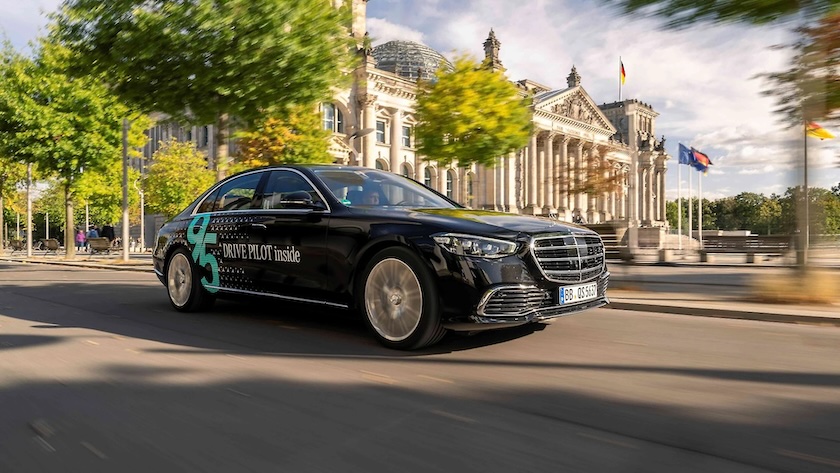
So the technology is there, but obviously it has to keep developing. Still, it has reached an important milestone: When the car drives autonomously (level 3), the driver can legally do other stuff (like look at her phone, yay!) and if there’s an accident, it will be Mercedes’ responsibility, not hers. I guess this alone means they believe in their technology.
So are we all going to own self-driving cars in the future?
I think not, and the reason is another area that has made great progress: ridesharing (which we could call Ride as a Service, RaaS) and car sharing (Car as a Service, CaaS). RaaS has been around forever (think Taxis), but of course now has been commoditized through providers like Uber.
CaaS is also nothing new – there have been car sharing organizations since 1948 (says Wikipedia), and I remember they were a thing in alternative circles in Germany in the 1990s. They have also benefited tremendously from digital transformation and smartphones. I currently use Miles in Berlin, which often has several cars parked on my street that I can walk up to and access using their app (of course, I registered using my driving license before). Prices are typically around 0,89 € per km, making it significantly less than a taxi.

What about public transport though?
At this point, it is important to point out that public transport is still the most efficient way to transport people (in terms of cost, space used, …). Consider this old image, which visualises the space used up by people in cars versus a bus:
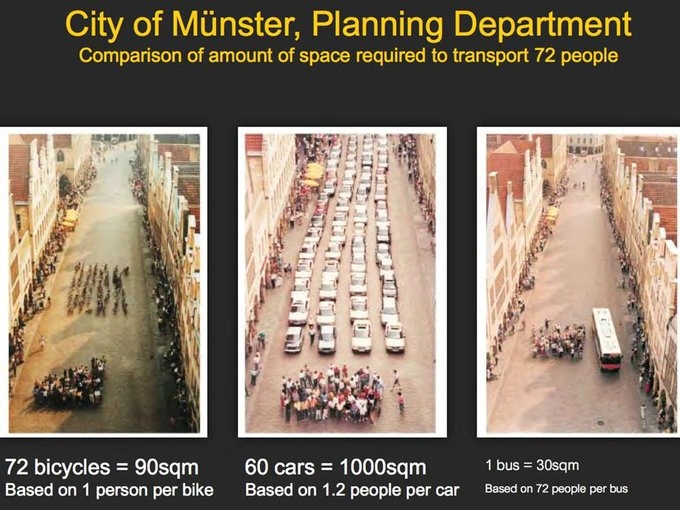
Now, public transport organisations are also experimenting with RaaS, with a public transport flavour: rides are typically shared between several people, and the services are offered as part of an existing public transport network.
Enter Flexline
Which brings me to my second bit of interesting news, which I discovered when visiting family in Landau, a beautiful small (pop. 48.000) town in the wine region of Rhineland-Palatinate that already has a great network of busses running frequently. This is now complemented by a service called flexline, which allows everyone in the city to book a shuttle to go from A to B, 24 hours a day and for the price of a public transport ticket. In my case, this was free, as I already have a Deutschlandticket giving me free local public transport anywhere in Germany for a flat fee (currently 58 €/month).
In my case, I pulled out the app and told it where I wanted to go (n km). The app figured there was a bus going the same direction in 20 minutes so told me there’d be no shuttle this time (working as intended). It was different on the way back as there was no bus coming up. Instead, I was told that a shuttle would arrive in 20 minutes. Indeed, a small minivan arrived soon, and I had to share a ride code (string of 4 characters) with the driver to identify myself, and to show my ticket. There was one lady already on it who was going a similar direction. I was dropped up near my target destination without much fuss.
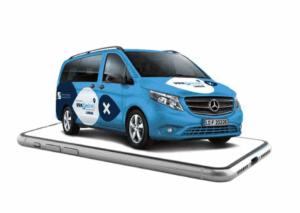
Obviously, my shuttle was not running autonomously, but since the technology is there (see above), it is easy to imagine how it would support such systems in the future. Not having a driver would reduce running costs significantly, so many more shuttle buses could run. Initial investments would still be huge though.
Then again, having affordable/ free with a subscription transport available 24/24 would reduce the need for many people to own their cars (maybe not disabled citizens, families, or people who need a car to do their job). Then the interesting question becomes: Will people still want to own their car? I understand in Germany, car ownership is an emotional issue, but what if the monthly price were significantly lower? Owning a car easily costs between 500 € and 1.000 € a month, according to statistics by the ADAC motoring association.
So would we see a future with a lot fewer cars on the road? And, if/ when this happens, what becomes of the car industry? The German car industry is huge but has lost a good part of its edge as it was too late offering attractive electric cars. Also, digitalization is still lagging behind carmakers in other countries.
So, what does all this mean?
In our Digital Transformation Master, I teach my students about the importance of business models. DT is not about rebuilding what you used to have in a digital way, but about creating something entirely new. Tilson et al. (2010) show how „the first ‚digital‘ services were equivalents of existing analog functionality, built and organized in ways aligned with existing social and technical infrastructures“ (p. 749), which they termed „digitizing of the cow paths“ (p. 750). One example they give is music CDs instead of LPs – they are digital, but serve the same purpose. On the other hand, digitalization has led to flexibility and generativity, enabling new „infrastructures“ around music, from iTunes to Spotify etc.
How would mobility work in a perfectly digitalized world? I think business models like Caas and RasS are an important part of the answer. Indeed, Verhoef (2021, p. 891) directly relates digital transformation to business models: “Digital transformation introduces a new business model by implementing a new business logic to create and capture value“.
So I think there will be new business models that will make it unnecessary for many (most?) people to own their cars, I hope they will also be part of smart networks integrating autonomous cars with public transport.
References:
- Tilson, D., Lyytinen, K., & Sorensen, C. (2010). Digital Infrastructures: The Missing IS Research Agenda. Information Systems Research, 21(4), 748–759. https://doi.org/10.1287/isre.1100.0318
- Verhoef, P. C., Broekhuizen, T., Bart, Y., Bhattacharya, A., Qi Dong, J., Fabian, N., & Haenlein, M. (2021). Digital transformation: A multidisciplinary reflection and research agenda. Journal of Business Research, 122, 889–901. https://doi.org/10.1016/j.jbusres.2019.09.022