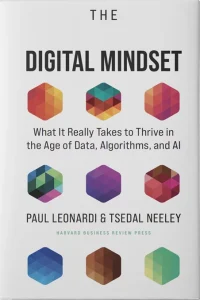
Digital firms have quietly gone about setting their own rules for how businesses should be run (see e.g. How Google Works by Schmidt & Rosenberg, 2014) – a good few of those now apply to organizations way beyond the digital industry. How much and why? This is the topic of the book „The Digital Mindset“ by Paul Leonardi and Tsedal Neeley, which I just came across.
I already knew Paul as an eminent professor in my field (Information Systems), who had published on heavy topics like materiality or constructivism. This book is much more down-to-earth: Its key message is that a digital mindset is necessary to understand and seize the opportunities of digital transformation.
„I’m not technical enough“ – but you should be
There’s an issue in organizations (definitely in German ones) that leaders think „I’m not technical enough“, so they refuse to touch any technical issues, leaving them to „IT“. On the contrary, Leonardi and Neeley argue that we are all digital workers, so we all need some basic „IT“ skills – the digital mindset. What and how much? Their 30% rule says that you don’t need to know everything – having some basic skills in key areas (as in: knowing 30% about them) is enough. In order to go about it, they argue for redefining three key processes: Collaboration, Computation and Change.
Collaboration – With AI and Humans
Even though the book was published in 2022 and was likely finished before ChatGPT came along, there is a substantive part on how to work with AI tools (good foresight there!). There’s a nice balanced view given: On the one hand, the authors argue that „in many cases, machines are better than humans at making certain predictions and doing specific tasks“ (p. 36), so we should learn to trust them. On the other hand, they say AI should be treated like a machine, even if it seems to act like a human, so companies should make it clear when users are interacting with an AI agent. The latter idea is a bit lost on certain of my acquaintances who list ChatGPT as one of their friends… There’s also some useful advice on how to stay connected to co-workers in a virtual work environment by cultivating „digital presence“.
Computation, or: Not everything that can be counted counts
The Computation chapters mainly look at data and how it is used in organizations. Developing digital skills here also means becoming comfortable with analytics, knowing what questions to ask of the data and avoiding common pitfalls. I guess Paul’s academic background shines through in quotes like „the way we classify the data we collect is always a socially informed decision and therefore subjective rather than objective“ (p. 84). Consequently, a basic level of statistics skills is necessary on order to work with data analytics, starting with basics like „correlation is not caution“ and the classic „not everything that can be counted counts, and not everything that counts can be counted“ (incorrectly ascribed to Einstein – I tracked it down to Cameron (1963, p. 13) in my thesis…).
Securing and Managing Change
Finally, there’s some useful advice on cybersecurity in the Change chapters (it’s not a matter of if your data becomes vulnerable, but when, so plan with security and privacy top of mind). Likewise, the authors make a case for encouraging experimentation (build a culture of psychological safety) – apparently, this is still not the case in many organizations. The last chapter focuses on leadership, and this is where the concept of the Digital Mindset becomes obvious: While technology is essential for digital transformation, the focus in organizations should really be on the mindset shift. Teams must become agile, autonomous and collaborative to deal with constant and on-going change. On the one hand, this means that every team member must become tech savvy. On the other, it stresses the role of management in enabling this mindset shift and supporting their teams along the way.
So What?
I think this book points out a shift that not everybody is aware of yet: IT is not just a question of the IT department anymore. It shapes and affects all aspects of business/ work/ collaboration. Consequently, deciding not to know anything about IT is not an option anymore.
In my class „Projekt: Digitale Transformation“, students are working with maturity models (e.g. Bitkom’s Reifegradmodell Digitale Prozesse) in order to estimate the current and desired level of digitalization in an organization (often, the company they work for). Here, Skills and Culture is a key category (along with more expected ones like Technology or Process Data), and Digital Mindset is one aspect of it. Which is great, because without the right skills and culture, digitalization projects may be doomed from the outset (see our paper on the class here (in German)). I love the general idea that everyone needs some basic digital skills and, specifically, a digital mindset. I hope the idea catches on more broadly that this should not be restricted to IT departments as everyone will have to make sense of the new, digital world.
References
- Cameron, W.B., 1963. Informal sociology, a casual introduction to sociological thinking. New York: Random House.
- Leonardi, P., & Neeley, T. (2022). The Digital Mindset: What It Really Takes to Thrive in the Age of Data, Algorithms, and AI. Harvard Business Review Press.
- Schmidt, E., & Rosenberg, J. (2014). How Google Works (New Edition). Grand Central Publishing.